Incident Communication Template
Ready-to-use messages for each stage of an IT incident, from the first alert to the postmortem, so users and management know what’s happening.
During an outage, silence often creates more pressure than the outage itself. People fill the gap with guesses, the service desk takes calls it can’t answer, and management starts asking for updates one by one.
These templates help the right people hear from you early, regularly and in plain language. That also gives the technical team room to focus on the fix.
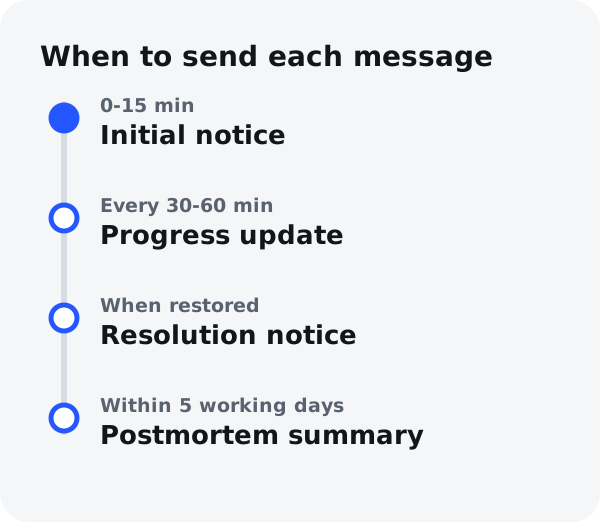
1. Initial Notice (Within 15 Minutes)
[Investigating] [Service name] is unavailable / degraded
We’re aware that [service] is [unavailable / slow / showing errors] for [who is affected] since [time]. Our team is looking into it now.
Workaround: [if any, otherwise "None at this time"]
Next update: [time, e.g. in 30 minutes]
2. Progress Update (Every 30–60 Minutes)
How often to update depends on the priority. The incident priority matrix suggests a schedule for each level.
[Identified / Monitoring] [Service name]
Status: [what we know now, in one or two sentences]
Impact: [who and what is still affected]
What we’re doing: [current action]
Next update: [time]
3. Resolution Notice
[Resolved] [Service name] is back to normal
[Service] has been working normally since [time]. Total impact: [duration] for [who]. Thank you for your patience.
Cause (short): [one sentence, no blame]
Next: We’ll share a summary of what happened and what we’re changing by [date].
4. Postmortem Summary (Within 5 Working Days)
The table below is the short version. For the full review, use the blameless postmortem template.
| Section | What to write |
|---|---|
| Summary | What happened, in three sentences |
| Impact | Who was affected, for how long, and any business impact |
| Timeline | When it was detected, escalated, mitigated and resolved |
| Root cause | The underlying cause, not just the trigger |
| What went well | Detection, teamwork, tools that helped |
| What we’re changing | Actions, each with an owner and a due date |
Who to Inform
- Affected users: the initial notice, updates and the resolution notice
- Management: the same messages, plus business impact and expected cost
- Service desk: everything, and before anyone else, so they can answer calls
- Vendors: when they’re involved in the fix, with a clear owner on each side