Disaster Recovery Test Checklist
A practical checklist for planning, running and reviewing a DR test, so you know the recovery plan works before you need it.
A DR plan that has never been tested is closer to an assumption than a plan. Recovery depends on details that only show up when you try it: credentials, firewall rules, the order systems come back in, and how long each step really takes.
The steps below help you run the test without putting production at risk, and measure the result against your recovery targets.
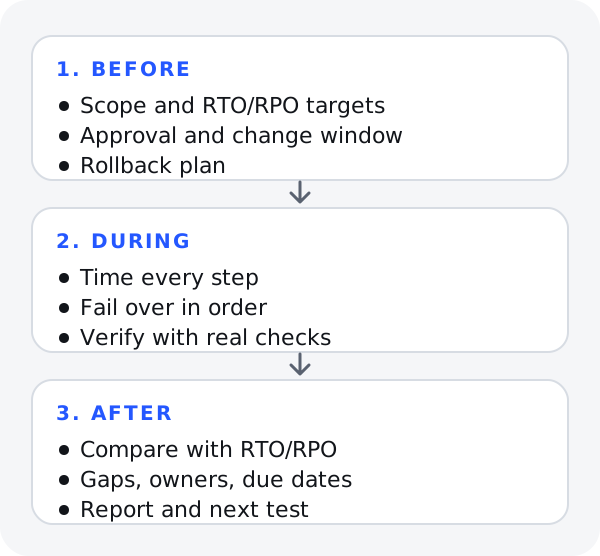
Before the Test
- Define the scope: which systems, sites and scenarios are included
- Confirm the targets you’re testing against: RTO (how fast you need to recover) and RPO (how much data loss is acceptable)
- Get written approval from system owners and management, and agree who makes the go/no-go call
- Schedule a change window and let users, the service desk and vendors know
- Check that the latest backups and replication are healthy
- Prepare a rollback plan in case the test itself causes problems
- Assign roles: test lead, technical lead for each system, timekeeper, note-taker
- Write a test script with the steps, expected results and pass/fail criteria
During the Test
- Start the clock and log every step with a timestamp
- Fail over in the planned order (network, then infrastructure, then applications)
- Verify each system with real checks: login, a sample transaction, how recent the data is
- Note any manual workarounds or steps that are missing from the plan
- Measure the actual recovery time and data loss for each system
- Fail back, or confirm the plan if you will keep running on the DR site
After the Test
- Compare the actual results with the RTO and RPO for each system
- List the gaps, each with an owner and a due date
- Update the DR plan and runbooks with what you learned
- Send management a short report: scope, results, gaps and the next test date
- Schedule the next test (at least once a year for critical systems)